Sunday, March 20, 2011

Spring Has Sprung!

Yes, Spring will officially have arrived on March 20, 2011, at 7:21PM EDT (that's us), or 11:21PM Universal Time which is the mean solar time for the meridian at Greenwich, England, used as a basis for calculating time throughout most of the world. Also called Greenwich time, Greenwich Mean Time or UT.

So, say goodbye to winter and say hello to spring with temperatures slowly rising to greet the vernal (spring) equinox. Do you remember what equinox means?

The word “equinox” derives from the Latin words meaning “equal night” and refers to the time when the sun crosses the equator. At such times, day and night are of nearly equal length everywhere in the world.

It is important to note that while the March equinox marks the beginning of spring in the northern hemisphere, it is the start of autumn in many parts of the southern hemisphere.

Yes, it's Spring, when the earth awakens from winter sleep! What a beautiful season this is, with the spring flowers sprouting and the grass turning green, the earth comes alive, and I think we all feel a little more alive, just like that cute little kitten running through the grass.
It’s also a time of balance, when light and dark are equal for a short period of time until the blissful sunshine takes over the better part of our days.

Although we may still have some cold and gloomy days outside, there is sunshine in our hearts because we know today is the first day of Spring! I always love the changing of the seasons.

Spring is when you feel like whistling even with a shoe full of slush.
~Doug Larson

What can we expect weather wise in Spring and otherwise?
-
Tornado Season
This picture of a tornado in NYC was taken July 7, 1976

March is the traditional start of tornado season in the United States. Although tornadoes can occur at any time throughout the year, the peak activity period is March through early July, according to the National Weather Service (NWS).

An average of 1,200 tornadoes touch down in the United States each year, and most of them form during this tornado season. Because these storms kill about 70 Americans annually and injure some 1,500 others, disaster experts urge families to be prepared — particularly those who live in Tornado Alley.

Tornado Alley is roughly defined as the area of the Central Plains from Texas to Nebraska. This is where most tornadoes form each season. Much of the damage that tornadoes inflict each year occurs in this region of the country. Texas has the highest number of tornadoes, with an average of 124 each year. You may want to stay away from those areas during tornado season.

The first day of Spring - Really?
We heard the forecast for tomorrow, rain possibly mixed with snow. That's March for you. Winter is not ready to leave yet. There have been major snow storms even in the spring
Also, remember too, not only does Spring bring to life the beautiful flowers, but also the weeds and allergies with it.
I found this cute poem that describes the reality of Spring. I think you will like it.
-
First Day of Spring
It is the first day of Spring today!
The birds are singing ecstatically
The grass seems to actually look greener
The warm air signals that winter is leaving…
though it may take its time packing
in some areas of the country.
Soon the trees will begin to break forth in buds
Seedlings will start their journey
through the earth …to meet the sky
While hibernating creatures all over the planet
will begin to wrestle out of their sleep
to rejoin the animal kingdom.
So will my life change as well
I will wake up with eyes that are itching
Nasal passages that will swell and begin to close
Lungs that will feel scratchy…then become congested
Requiring over the counter medicines to burst forth…
YES…IT’S THE FIRST DAY OF SPRING!…(sigh)
-M.E.Gaines

So goodbye winter you were good to me this year. See you again in 9 months from now? Wow, that's not that far away, can you believe it? Or I will see you eleven days before the Kalends of January according to the Roman calendar.

Hello Spring, may we all spring into action especially in the Lord's work!

This is Raven-as the crow flies!

Monday, March 14, 2011

Beware Of The Ides Of March!

That line "Beware of the Ides of March," is a pithy line and people remember it, even if they don't know why. Who said it? Why? And what does it mean? Hopefully this blog will answer those questions.

That line was made popular in William Shakespeare's play Julius Caesar by a soothsayer warning of impending danger to Julius Caesar.

The soothsayer tells Caesar who is already on his way to the Senate (and his death), "Beware the ides of March." Caesar replies, "He is a dreamer, let us leave him. Pass." The Roman ruler, Julius Caesar, was assassinated on the Ides of March - March 15, 44 B.C.E.

According to Plutarch's (a biographer and an historian) account of the story written in 75 A.D., the unidentified soothsayer was a Roman astrologer by the name of Spurinna. It was reportedly sometime prior to the fateful day of March 15 that Spurinna had first given Caesar the famous warning to "beware of the Ides of March." The astrologer, Spurinna, had previously warned Caesar that on the Ides of March, he would be in great danger. If, however, Julius Caesar took care on that one day - then all would be well.

According to Plutarch, Caesar had previously made the wise decision to stay within the safety of his bedroom chambers on the 15th of March. However, Caesar's "friend" Decimus (Albinus) Brutus (not Marcus Brutus) managed to convince him that the astrologer's warnings were nothing more than superstitious foolishness. So Julius Caesar decided to attend the Senate on the 15th of March. On his way to the Senate, Caesar "accidentally" met up with the astrologer, Spurinna. Caesar then told the astrologer "The Ides of March are come." Spurinna answered, "Yes, they are come, but they are not past." Later that day - on March 15, 44 B.C.E - Caesar's enemies assassinated him in the Pompey theater, at the foot of Pompey's statue, where the Roman Senate was meeting that day in the temple of Venus.


Et tu Brute
"Thou, too, Brutus!" Julius Caesar's exclamation when he saw that his old friend, Marcus Brutus (85-42 BC), was one of his assassins. "Does my old friend raise his hand against me?"

What Are the Ides?

In the ancient Roman calendar, each of the 12 months had an "ides." In March, May, July and October, the ides fell on the 15th day. In every other month, the ides fell on the 13th.

The word "ides" was derived from the Latin "to divide." Ides just means the middle of the month according to the Roman calendar.

Basic Roman Calendar

The Kalends
fell on the first of each month
The Nones were on the 5th or 7th (depending on the month) and
The Ides fell on the 13th or 15th, again depending on the month.

The Romans did not count days of the month from 1-30, but rather the day before the Nones of March or the Day before the Ides of April.

In the case of April, the day before the Ides would be what we call April 12, because the Ides of April (unlike March) fall on the 13th.

The date was never spoken in the past, as in the day after the Ides. It was always in relation to the upcoming of the 3 days. April Fool's Day was The Kalends of April.

The Roman Calendar is basically broken down as follows:

The Kalends:
March 1, April 1, May 1, June 1, July 1, August 1, September 1, October 1, November 1, December 1, January 1, February 1

The Nones:
March 7, April 5, May 7, June 5, July 7, August 5, September 5, October 7, November 5, December 5, January 5, February 5

The Ides:
March 15, April 13, May 15, June 13, July 15, August 13, September 13, October 15, November 13, December 13, January 13, February

So for example, if your birthday fell on November 21 in the Roman calendar it would be ten days before the Kalends of December.

And so, it was the Ides of March in 44 BC, that Julius Caesar was betrayed by friends and murdered in the streets of Rome.

Until that day Julius Caesar ruled Rome. The traditional Republican government had been supplanted by a temporary dictatorship, one that the famous leader very much wished to make permanent.

But Caesar's quest for power spawned a conspiracy to have him killed, and on March 15 a group of prominent Romans brought him to an untimely end in the Senate House. He was 55 years old.
Of all the lines in the play, "Beware of the Ides of March" seems to be the one most people remember, followed closely by (or perhaps surpassed by) "Et tu, Brute?"

I hope this blog has helped you as much as it has helped me to know the meaning of that popular phrase.

Until we meet again...

This is Raven- as the crow flies!

Saturday, March 12, 2011

The Crow Moon In March


What Is A Crow Moon? The Crow Moon is the last full moon before the arrival of Spring, when the snow and ground begin to thaw.

To keep tract of the seasons, the Native American tribes of the northern and eastern part of the United States (from New England to Lake Superior), would give each full moon a distinctive name. The full moon in March was known as a Crow Moon or Full Crow Moon, when the cawing of the crows signaled the end of winter.

This year the Crow Moon falls on March 19th, 2011.

It is of interest to note the Crow Moon was also called the Worm Moon because as the temperature in March begins to warm and the ground begins to thaw, earthworm casts appear, heralding the return of the robins.

Another name the moon was given this time of year was Full Crust Moon, because the snow cover becomes crusted from thawing by day and freezing at night.

Then too, It was also know as Full Sap Moon, because it was marking the time of tapping maple trees.

However to the settlers, it was also known as the Lenten Moon, because this moon occurred during Lent and was considered to be the last full moon of winter.

And so my dear friends, The Crow Moon will soon be upon us, and what that means is winter is coming to an end and Spring is around the corner.

However, because March brings in spring and ends the winter, March can be both wintry and springlike. Blustery, windy days occur as frequently as mild, sunny days, so don't put away the winter clothes just yet.

Have you seen any signs of spring yet, like hibernating animals such as bears (depending on where you live), chipmunks, and woodchucks leaving their winter sleeping places ending their hibernation? Also, this is the time you will see sap flow in the trees, and green buds beginning to appear, and many plants coming to life again. The first pussy willows and wild flowers can be found in the woods and our back yards. Most frogs lay their eggs. Wild geese and ducks begin their northward flights.

So March, you fickle month, what can we expect? Let it be said in rhyme:

"The March wind roars
Like a lion in the sky,
And makes us shiver
As he passes by.
When winds are soft,
And the days are warm and clear,
Just like a gentle lamb,
Then spring is here."
- Author Unknown

Spring Cleaning

"March bustles in on windy feet
And sweeps my doorstep and my street.
She washes and cleans with pounding rains,
Scrubbing the earth of winter stains.
She shakes the grime from carpet green
Till naught but fresh new blades are seen.
Then, house in order, all neat as a pin,
She ushers gentle springtime in."
- Susan Reiner

"It was one of those March days when the sun shines hot and the wind blows cold: when it is summer in the light, and winter in the shade."
- Charles Dickens

"March is a tomboy with tousled hair, a mischievous smile, mud on her shoes and a laugh in her voice."
- Hal Borland

Remember to push the clocks ahead for Sunday March 13th, And oh yes, "Beware of The Ides of March."

This is Raven- as the crow flies!


Saturday, February 19, 2011

The Difference Between Crows and Ravens

I have been wanting to write about this topic for a long time, mostly because of my fondness for crows and ravens. Not only are they beautiful, but they are very intelligent as you will discover from this blog. What is the difference between Crows and Ravens?

Many people use the terms 'raven' and 'crow' interchangeably, but they are actually quite different. Technically, since ravens belong to the crow (corvus) family of birds, they can be called crows - but not all crows are ravens. The two differ in a variety of ways.

Size First. Most noticeably, ravens are larger than crows. They are (on average) about the size of a hawk, where crows are approximately the size of a pigeon. A raven can be up to 64 cm in height, a crow’s height ranges up to 46 cm.

Call. If you're familiar with the call which crows make, you'd probably recognize the raven's call as being different. Crows have a more nasal, higher pitched call, where a raven's call is lower, and hoarser... almost a croaking sound. And if you have listened to the cries of both the birds, you will know that a crow’s sound is more irritating than that of ravens. A raven has the capability to imitate certain sounds as well.  If you want to hear the difference for yourself, click here for a raven's call and crow's call.

Tail feathers

Crows have a very fan-shaped tail, where raven's tails have more of a wedge-shape to them. This isn't very easy to tell if the bird is sitting on the ground, but when flying overhead, you can often get a good look at the shape of the tail.

Feather shape

Ravens' feathers are also a slightly different shape than crows' feathers. Crow feathers tend to be more rounded at the tip, while ravens have feathers which are slightly pointed. This is most noticeable on the breast feathers, especially when the bird fluffs itself up. The feathers on the crow's breast lie comfortably against each other and provide a nice, even, rounded covering. The feathers on a raven lie a little more jaggedly, and when a raven fluffs up, its breast tends to look ragged. In fact, when a raven really fluffs up and all its feathers look like they're standing on end, the raven appears to have a short fluffy mane (called a 'ruff'). Raven’s feathers are shiny and have a tint of purple when the sun rays fall on it. But crows have plain black feathers which can also have lighter markings on them.

Habitat

Ravens and crows can often be found living side by side in the same areas, but where there's a choice, Ravens prefer wilder areas while crows will live quite close to cities. The bigger the city, the less likely ravens will make it their home -- and when they do, they tend to live in or near parks and natural spaces. You can find crows in your garden, neighboring places, electric lines, and even in highly bustling places. But ravens cannot be found like that. They like solitude and privacy and hence are found in the woods and hills where human population is less or nil. Crows, on the other hand, are more likely to live near buildings, and will venture farther into human developments to compete for food.

There are more differences between crows and ravens, including their social habits and life span While a crow lives up to 8 years, a raven can live up to 30 years.

Food Habits

The food habits of ravens and crows also are different. When crows scavenge for fruits, vegetables, and other foods in groups, ravens hunt solitarily. So crows are never the friends of a farmer as it destroys the crops. That's why many farmers and gardeners put up the well known 'scarecrow' in there fields.Though both birds are omnivorous and scavenge on carrion, ravens feed more on the carrions, especially sheep.

Intelligence

Though parrots are very smart, they aren’t the only birds with brains. Members of the corvid family – jays, crows and ravens – are extremely smart too.

Corvids can remember, analyze, innovate and problem solve. They even use tools. In every case, ravens shine. They are one of the most intelligent birds on earth, persistent and innovative in solving problems and known to outwit other critters, a feat which earned them human tributes as tricksters and gods. Ravens even play.

The Common Raven is an acrobatic flier, often doing rolls and somersaults in the air. One bird was seen flying upside down for more than a half-mile. Young birds are fond of playing games with sticks, repeatedly dropping them, then diving to catch them in midair.

There are more differences between crows and ravens, but these are the key points. They should help you determine whether the bird you're looking at is a raven or just a very large crow.

In Summary

1. Crows and ravens differ in the size and ravens are bigger.

2. Ravens have a purple shiny tint on the feathers when sunrays fall on them, while crows have plain dark feathers.

3. The life spans of crows are very less compared to that of ravens.

4. Crows scavenge in groups while ravens hunt in solitude.

5. Crows can be found among the dwellings of humans, but ravens prefer to stay away in the hills and woods.

I want to do another blog at some future time, to share with you more information on how smart Crows and Ravens really are. It is truly amazing. Until then......

This is Raven-as the crow flies!

Tuesday, February 1, 2011

February - An Anniversary Month!

February 2, 2011 will mark the first year anniversary when Raven's Delights began.

You may recall the first blog gave helpful information on how to identify healthful fruits and vegetables by their number code. Hopefully that has been a benefit to you.

The birth of this blog has been an interesting adventure which much of the credit, if not all, goes to Sparrow and Swallow, who encouraged me to "get out of the box", and try my hand at blogging. It had an appeal to me and of course the rest is history.

One of my quests with the creation of this blog, was to find out how each month of the year got it's name.

When I searched my past blogs for the month of February, to my surprise, I neglected to accomplish this task for the month of February, 2010. So to honor this goal, on the month I started this blog, February, a year ago, I will meet my objective this anniversary month by telling all how February got it's name.

February Facts

February is the second month of the year according to the Gregorian calendar, which is used in almost all the world today. It is also the shortest month.

According to legend, the first calendar of the ancient Romans had only 10 months. But in about 700 B.C., the ruler Numa Pompilius added January and February. February became the last month of the Roman year.

The month takes its name from the Latin word februare, meaning to purify. The Romans purified themselves in February to prepare for festivals at the start of the new year. Later, the Romans moved the beginning of the year from March to January, making February the second month.

February usually had 28 days until the time of the Roman statesman Julius Caesar. Caesar gave it 29 days in standard years and 30 every four years. According to tradition, the Roman emperor Augustus took one day off February to add to August, the month named after him. Today, February has 28 days in standard years and 29 in leap years.

A Leap year has 366 days, or one more day than an ordinary year. Leap year day occurs once every 4 years. The next leap year will be in 2012.

Why is it called a Leap Year?

Hundreds of years ago the leap year day had no recognition in English law. The day was 'leapt over' and ignored, hence the term leap year.

Leap years were added to the calendar to make the calendar year nearly the same as the solar year, which is the time it takes for the sun to pass the vernal equinox twice. The extra day added every four years brings a solar year of 365 1/4 days into line with the calendar year of 365 days.

February Second is Groundhog Day.

Groundhog Day in the U.S. is a popular tradition, the day (February 2) that the groundhog, or woodchuck, comes out of his hole after winter hibernation to look for his shadow; If he sees his shadow, it foretells six more weeks of bad weather; If he cannot see his shadow because of clouds, Spring is coming. Supposedly he goes back into his hole if more bad weather is coming and stays above ground if spring is near; statistical evidence does not support this tradition.~Excerpted from Compton's Interactive Encyclopedia~
"Away in a meadow all covered with snow
The little old groundhog looks for his shadow
The clouds in the sky determine our fate
If winter will leave us all early or late."- Don Halley


Weather-lore for February

It is said that if the weather is fine and frosty at the close of January and the beginning of February, there is more winter ahead than behind.

When the cat lies in the sun in February
She will creep behind the stove in March

Of all the months of the year, curse a fair February

If it thunders in February, it will frost in April

If February gives much snow, A fine summer it does foreshow.

So far, the beginning of this month looks like the groundhog will be seeing his shadow, so keep those winter hat's, scarves, gloves, boots, and coats on for at least another six weeks.

I want to take this opportunity to also congratulate Sparrow and Swallow on their 1st year anniversary of their blog "Birds of a Feather." Kudos to you both. I know that "Frabjous Photo's" will be just as successful.

Thanks for the inspiration and encouragement you have given me.

What will I be blogging about, hopefully, for another year? Time will tell. One thing for sure, where ever the crow flies, Raven will be there.


This is Raven-as the crow flies!


Thursday, January 27, 2011

The Wonder of Snowflakes!

Snowflakes, are one of God's finest masterpieces. “How many your works are, O Jehovah! All of them in wisdom you have made. The earth is full of your productions.” Psalm 104:24; 148:1-5.
This of course includes SNOW.

So far we have had 34.8 inches of snow this month of January. The previous January record was 26 inches in 1947, the first year statistics were kept at Brookhaven National Laboratory.

This January's snow is also the most for any single month. The previous high was 32.5 inches in February 1967. By the way, February is typically the snowiest month on Long Island, according to the National Weather Service.

With 19.8 inches that fell in last month's blizzard, this season's total so far is 54.6 inches. The record was set in 1995-96 with 90.75 inches, followed by 2004-05's 78.5 inches. Right now we are in 11th place, but almost two months of winter are still ahead. The average Long Island winter brings 32 inches, according to Newsday's January 28, 2011 paper.

So, as you can see, it has been a great winter, and it isn't over yet!

Some who live in a fast-paced society and who must travel may view snow merely as an obstacle. Yet, countless others view snow as a delight, producing a winter wonderland that opens up opportunities for special activities.

What do you know about snow? In effect, that was a question Jehovah asked Job:“Have you entered into the storehouses of the snow, or do you see even the storehouses of the hail, which I have kept back for the time of distress, for the day of fight and war?”

Oh, we know what a lot of it looks like, perhaps from photos of snowbanks or because we have actually seen plenty of snow, especially this year. But what of individual snowflakes? Do you know what they look like, maybe having examined them at their source?

Some men have spent decades studying and photographing snowflakes. A snowflake may be composed of a hundred delicate ice crystals in a variety of beautiful designs. The book Atmosphere says: “The endless variety of snowflakes is legendary, and although scientists insist that no law of nature forbids their duplication, two identical flakes have never been found. One search of epic proportions was conducted by . . . Wilson A. Bentley, who spent more than 40 years examining and photographing snowflakes through a microscope without ever finding two that were exactly alike.” And even if, in a rare case, two appeared to be twins, would that really alter the wonder of the staggering variety of snowflakes?

Each snowflake becomes a masterpiece of construction. Amazingly, no two have been discovered that are exactly alike, and there are enough possible combinations of patterns to suggest that there will never be such a discovery. Yet, all are six-sided in shape!

Snow—its origin, flake growth, and design—staggers the mind of scientists.

What is snow? Snow is a clustering of ice crystals crafted from the water vapor in the air. Temperature, humidity, and barometric pressure help sculpture the beautifully symmetrical shapes of ice crystals. When the temperature near the ground is above 32° F. (0° C.) snow may reach us as rain. But if the temperature is below 32° F., the tiny crystals will clump together to form a snowflake.

But there must be something that the moisture can be formed around, something that acts as a “seed.” What can be used? Any microscopic particles floating in the air will do—dust, salt, or even pollution. Around these nuclei, ice crystals will grow into flat six-pointed stars, hexagonal pillars, or sparkling needles. As snow tumbles slowly earthward from as high as six miles (10 km), it may collide with other crystals and stick to them, or it may shatter, forming more “seeds” for more crystals.

Here are two statistics that may surprise you: A cubic foot (.028 cu m) of snow may contain 10 million snowflakes. And it has been estimated that up to one half of the earth’s land surface and 10 percent of the sea, about 48 million square miles (124 million sq km), may at times be under this wintry blanket. With all that snow, is it possible that no two snowflakes are alike? Yes!

To try to understand why, let us consider just one more set of facts. Millions of water molecules, which can be arranged in many different ways, may form a single ice crystal. And it takes from one to more than a hundred of these ice crystals to make one snowflake. According to Charles Knight, physicist at the U.S. National Center for Atmospheric Research, if you put all these numbers in a computer, you would find that there are still more possible combinations of molecules in each snowflake than there have been snowflakes in all earth’s history.

In addition, the air around a flake shapes its growth. As mentioned earlier, moisture, temperature, and barometric pressure sculpture snow. However, wind molds its shape too. All four factors may vary from moment to moment. Falling snow may pass through air masses of varying temperature. The wind may blow it through any number of temperature and humidity ranges in its downward journey. And since no two flakes are likely to follow the same path to earth, each one should indeed be unique.

Besides snow being beautiful to look at, there are vital benefits for us and the earth.

Just as many enjoy a soft, warm blanket on a cold winter night, the earth has its own winter blanket. Thanks to snow, the fluctuations in temperature of the soil are moderated. The soil holds in the heat it had absorbed before it was covered. Thus seeds are protected and crops will grow for the next harvesttime.

The earth is not just insulated by the snow blanket, however; it is also fertilized. How so? Because of the vital nitrates that are deposited by the snow. In the 1970’s it was estimated that an average snowfall on prairie farms would deposit about $20 worth of nitrates per acre.

And did you know that snow is referred to as the most effective “dam” of any kind? The water is held back or stored in the form of snow. In this form it will wait until it is released by melting in the spring. Hence, snow holds back water as a dam does. Even then, thanks to its ability to reflect the sun’s rays, the snow will melt away slowly, and in this way much of the water will filter its way down into the soil instead of just flowing off.

The Bible outlined these benefits of rain and snow by stating: “The pouring rain descends, and the snow . . . [and] actually saturates the earth and makes it produce and sprout, and seed is actually given to the sower and bread to the eater.” (Isaiah 55:10)

Yes, for many of earth’s inhabitants, the water they drink and the food they eat, and even the electricity they use, may be directly or indirectly a result of tapping “the storehouse of the snow.”

Indeed, the more scientists study snowflakes, the more they appreciate, as The New York Times reported January 6, 1987: “Snowflakes obey mathematical laws of surprising subtlety.” Do you not agree that snowflakes are a tribute to the power and wisdom of their Maker? “For to the snow he says, ‘Fall earthward.’”—Job 37:6.

By growing snow crystals in the lab under controlled conditions, scientists have discovered that their shapes are determined largely by temperature and humidity. This picture summarises the crystal shapes formed under different conditions.

12-sided snowflake

This is actually two snowflakes joined together - one rotated at 30 degrees relative to the other. Such snowflakes are quite rare.

May this blog about snowflakes help us better appreciate our Creator and his magnificent qualities of love, wisdom, justice, and power.

And, may we, like snowflakes, work together, to accomplish a lot!

Snowflakes are one of nature's most fragil things. But just look at what they can do when they stick together."


This is Raven-as the crow flies!


Wednesday, January 12, 2011

Snow Days - A Time To Contemplate God's Great Works!

My last blog spoke about the fun things we can do during this winter season and I encourage you to comment if you can suggest any other ideas. My blogging friend Sparrow, reminded me too how snow days can be a "guilt-free"day for staying home to rejuvenate, and I couldn't agree more. Even our creator Jehovah God encourages us to do that.

Some time ago during my personal Bible reading I came across a scripture that I couldn't wait to share. It says, "For to the snow he says, 'Fall earthward'. And to the downpour of rain, even to the downpour of strong rains. On the hand of every earthling man he puts a seal For every mortal man to know his work." Job 37: 6,7. Infact that whole chapter and also Chapters 38-42 magnifies Jehovah's greatness through his creative works. So just as Jehovah informed Job of his wonderful works, and to think about them, he does so with us as well through the pages of his word the Bible, and his glorious creation. What a great time to do that, when we are "snowed in" to learn and think deeply about our magnificent God, and his outstanding works, which we know only the fringes of.

"By the breath of God the ice is given."


"For to the snow he says, 'Fall earthward'


"He is giving snow like wool. Hoarfrost he scatters just like ashes."


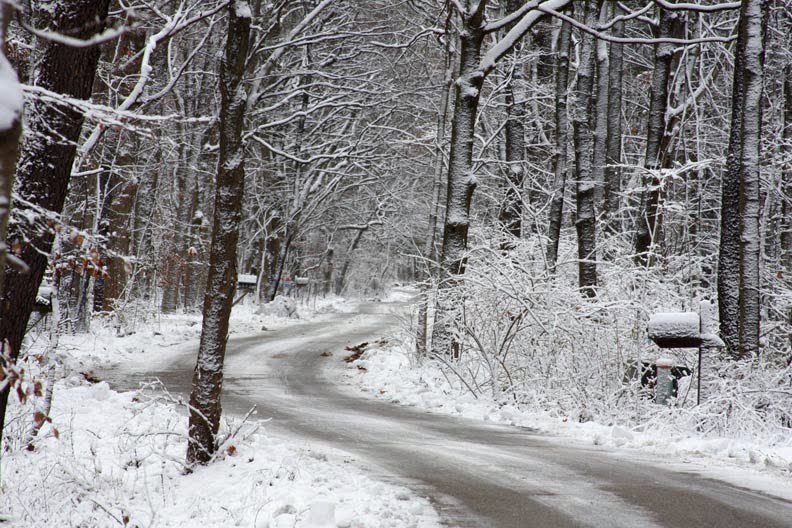
Today, January 12, 2011 proves to be one of those snowed in days. It started snowing last night about 9:00 or 10:00 p.m. and it is still coming down. I'm in my glory and I know Sparrow is too.

Take some time today to do things you wouldn't ordinarily do like; Sleep late. Watch a good movie snuggled under a blanket. Bake some cookies. Start a blog, or a scrapbook. Organize your photo's. Take pictures of the snow. Go for a nature walk in the snow. Break out an old board game. I haven't done that in years. Make a snowman, or woman. Or course shovel your driveway if you want to get out the next day. After you do that, you can come in to warm up by the fireplace drinking a cup of hot coca as you sit looking out of window watching the snow fall.

A priority to this list of course is to think about Jehovah. Contemplate his great creative works. Take time to look at each branch of a tree or bush that is laden with snow. Think about his wonderful cardinal qualities of love, wisdom, justice and power. If we enjoy the snow, he must too, because we are created in his image, he gave us things he knew that we would delight in.

Perhaps we can look up some of his qualities in the "Insight Book" on this snowy day, or how about look up information on snow and ice, it's there. This would be a good day to work on my return visit book, that will be a big job. I need about 3 snowed in days for that.

Snow is a four letter word. It is a gift from God and he's stopping all mankind from their work to take time to think about him, the provider of every good and perfect gift. Enjoy your snow day whatever you do!


This is Raven-as the crow flies!